Buy besthosting.eu ?
We are moving the project
besthosting.eu .
Are you interested in purchasing the domain
besthosting.eu ?
domain@kv-gmbh.de · 0541-91531010
Buy besthosting.eu ?
What is the difference between standard deviation and empirical standard deviation?
Standard deviation is a measure of the amount of variation or dispersion of a set of values. It is calculated by taking the square root of the variance, which is the average of the squared differences from the mean. Empirical standard deviation, on the other hand, is the standard deviation calculated from a sample of data, rather than the entire population. It is an estimate of the population standard deviation and is used to make inferences about the population. The empirical standard deviation tends to be slightly larger than the standard deviation, especially for small sample sizes, due to the use of Bessel's correction to account for the bias in the sample standard deviation. **
What is the difference between standard deviation and standard deviation of the mean?
Standard deviation measures the amount of variation or dispersion in a set of values, while standard deviation of the mean measures the amount of variation in the means of multiple samples. In other words, standard deviation gives us an idea of how much individual data points differ from the mean, while standard deviation of the mean gives us an idea of how much the means of different samples differ from the overall mean. Standard deviation of the mean is often used in statistical analysis to understand the variability in sample means and to make inferences about the population mean. **


Similar search terms for Standard deviation
Top-Angebote
Products related to Standard deviation:
-
Microsoft Windows SQL Server 2022 StandardSQL Server 2022 (15.x) builds on previous releases to grow SQL Server as a platform that gives you choices of development languages, data types, on-premises or cloud environments, and operating systems. SQL Server 2022 features: SQL Server Database Engine. SQL Server Database Engine includes the Database Engine, the core service for storing, processing, and securing data, replication, full-text search, tools for managing relational and XML data, in database analytics integration, and PolyBase integration for access to heterogeneous data sources, and Machine Learning Services to run Python and R scripts with relational data. Analysis Services. Analysis Services includes the tools for creating and managing online analytical processing (OLAP) and data mining applications. Reporting Services. Reporting Services includes server and client components for creating, managing, and deploying tabular, matrix, graphical, and free-form reports. Reporting Services is also an extensible platform that you can use to develop report applications. Integration Services. Integration Services is a set of graphical tools and programmable objects for moving, copying, and transforming data. It also includes the Data Quality Services (DQS) component for Integration Services. Master Data Services. Master Data Services (MDS) is the SQL Server solution for master data management. MDS can be configured to manage any domain (products, customers, accounts) and includes hierarchies, granular security, transactions, data versioning, and business rules, as well as an Add-in for Excel that can be used to manage data. Machine Learning Services (In-Database). Machine Learning Services (In-Database) supports distributed, scalable machine learning solutions using enterprise data sources. In SQL Server 2016, the R language was supported. SQL Server 2022 (16.x) supports R and Python. Data Virtualization with PolyBase. Query different types of data on different types of data sources from SQL Server. Azure connected services. SQL Server 2022 (16.x) extends Azure connected services and features including Azure Synapse Link, Microsoft Purview access policies, Azure extension for SQL Server, pay-as-you-go billing, and the link feature for SQL Managed Instance. The following features were improved in SQL Server 2022: Analytics Availability Security Performance Query Store and intelligent query processing Management Platform Language SQL Server 2022 Standard edition delivers basic data management and business intelligence database for departments and small organizations to run their applications and supports common development tools for on-premises and cloud, enabling effective database management with minimal IT resources.644,90 £*Shipping: 0,00 £Secure redirect to the provider
-
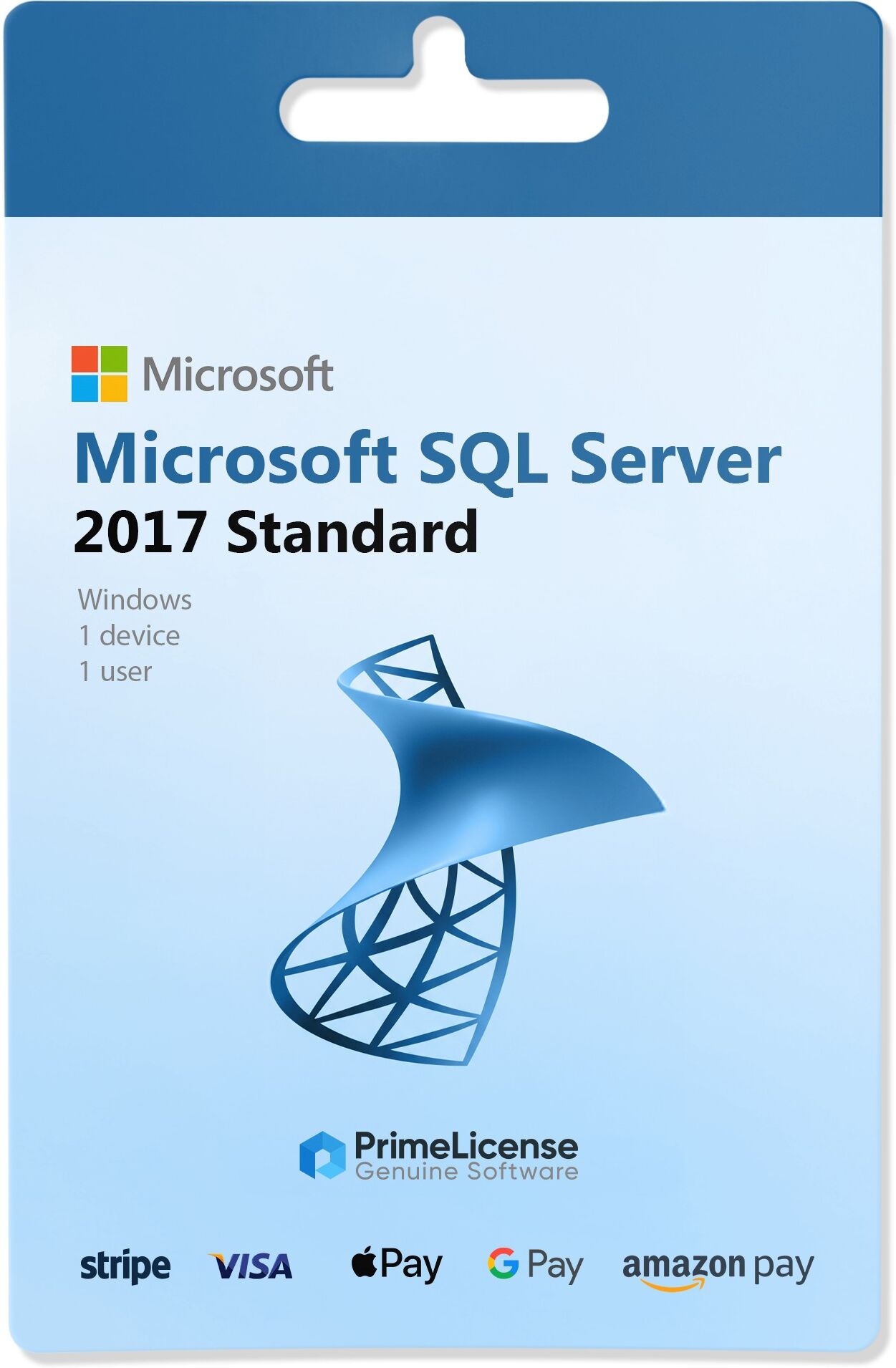
Microsoft Windows SQL Server 2017 StandardSQL Server 2017 (15.x) builds on previous releases to grow SQL Server as a platform that gives you choices of development languages, data types, on-premises or cloud environments, and operating systems. SQL Server 2017 (15.x) introduces Big Data Clusters for SQL Server. It also provides additional capability and improvements for the SQL Server database engine, SQL Server Analysis Services, SQL Server Machine Learning Services, SQL Server on Linux, and SQL Server Master Data Services. SQL Server 2017 features: SQL Server Database Engine. SQL Server Database Engine includes the Database Engine, the core service for storing, processing, and securing data, replication, full-text search, tools for managing relational and XML data, in database analytics integration, and PolyBase integration for access to Hadoop and other heterogeneous data sources, and Machine Learning Services to run Python and R scripts with relational data. Analysis Services. Analysis Services includes the tools for creating and managing online analytical processing (OLAP) and data mining applications. Reporting Services. Reporting Services includes server and client components for creating, managing, and deploying tabular, matrix, graphical, and free-form reports. Reporting Services is also an extensible platform that you can use to develop report applications. Integration Services. Integration Services is a set of graphical tools and programmable objects for moving, copying, and transforming data. It also includes the Data Quality Services (DQS) component for Integration Services. Master Data Services. Master Data Services (MDS) is the SQL Server solution for master data management. MDS can be configured to manage any domain (products, customers, accounts) and includes hierarchies, granular security, transactions, data versioning, and business rules, as well as an Add-in for Excel that can be used to manage data. Machine Learning Services (In-Database). Machine Learning Services (In-Database) supports distributed, scalable machine learning solutions using enterprise data sources. In SQL Server 2016, the R language was supported. SQL Server 2017 (15.x) supports R and Python. Machine Learning Server (Standalone). Machine Learning Server (Standalone) supports deployment of distributed, scalable machine learning solutions on multiple platforms and using multiple enterprise data sources, including Linux and Hadoop. In SQL Server 2016, the R language was supported. SQL Server 2017 (15.x) supports R and Python. SQL Server 2017 Standard edition delivers basic data management and business intelligence database for departments and small organizations to run their applications and supports common development tools for on-premises and cloud, enabling effective database management with minimal IT resources.85,90 £*Shipping: 0,00 £Secure redirect to the provider
-
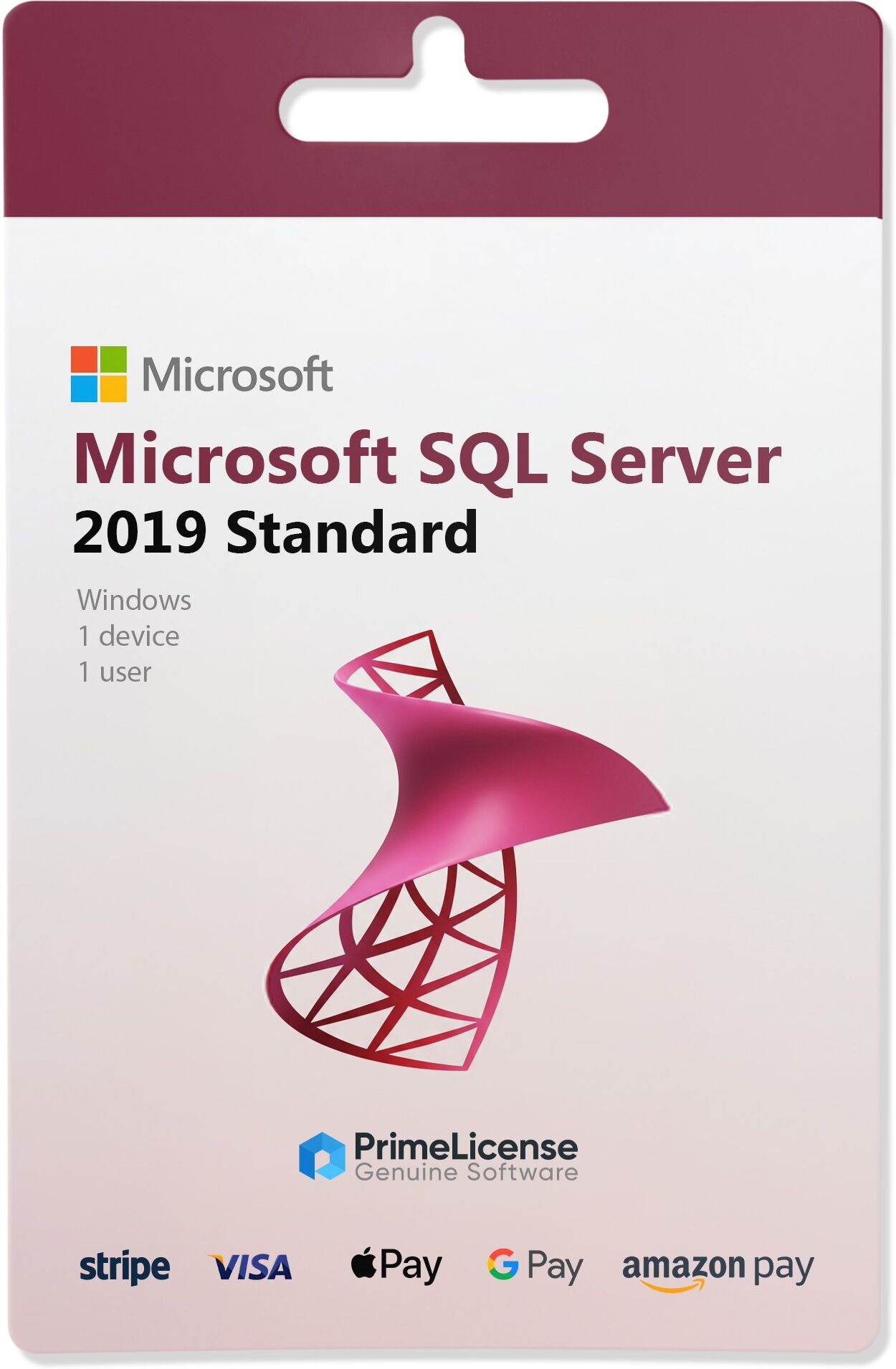
Microsoft Windows SQL Server 2019 StandardMicrosoft sql server 2019 - features and functionality SQL Server 2019 (15.x) represents an advancement over its previous versions, expanding the SQL Server platform with a wide range of choices across development languages, data types, on-premises or cloud environments and operating systems. It also introduces Big Data Clusters for SQL Server, offering additional features and enhancements for several components, including SQL Server Database Engine, SQL Server Analysis Services, SQL Server Machine Learning Services, SQL Server on Linux and SQL Server Master Data Services. Key features of Windows sql server 2019 include: SQL Server Database Engine: The Database Engine is the central service for storing, processing and securing data. It includes replication, full-text search, relational and XML data management tools, integration with analytical databases and PolyBase for accessing Hadoop and other heterogeneous data sources, as well as Machine Learning Services for running scripts in Python and R on relational data. Analysis Services: Analysis Services provides tools for creating and managing online analytical processing (OLAP) and data mining applications, supporting advanced analysis. Reporting Services: Reporting Services provides server and client components for developing, managing and distributing reports in various formats, including tabular, matrix, graphical and freeform. It is also an extensible platform that can be used for the development of reporting applications. Integration Services: Integration Services consists of a set of graphical tools and programmable objects for transferring, copying and transforming data. It also includes Data Quality Services (DQS) to improve data integrity. Master Data Services: Master Data Services (MDS) is SQL Server's solution for master data management, supporting various domains such as products, customers and accounts. It offers hierarchy management, granular security, transactions, data versioning and business rules, with an add-in for Excel for simplified data management. In-database Machine Learning Services: In-database Machine Learning Services allows distributed and scalable machine learning solutions to be implemented, leveraging corporate data. It supports R and Python, extending the capabilities introduced in SQL Server 2016. Machine Learning Server (Standalone): Machine Learning Server (standalone) facilitates the deployment of scalable machine learning solutions on different platforms, including Linux and Hadoop, supporting the R and Python languages as was already the case in SQL Server 2016. The SQL Server 2019 Standard edition provides basic data management and business intelligence database for departments and small organisations to run applications and supports common development tools for local and cloud environments, enabling effective database management with minimal IT resources. Comparison with other Windows Server versions: SQL Server Standard 2019 unlike other Windows Server...119,90 £*Shipping: 0,00 £Secure redirect to the provider
-
Microsoft Windows SQL Server 2025 StandardMicrosoft SQL Server 2025 Standard is a professional-grade relational database platform designed for companies seeking a reliable, secure SQL engine ready for modern analytics and AI scenarios, without the complexity (and cost) of the Enterprise edition. General Description - SQL Server 2025 Standard offers a complete database engine for OLTP and mid-tier analytical workloads, ideal for ERP, CRM, web applications and business management. - It combines high performance, intuitive administration tools and native integration with the Microsoft ecosystem, including hybrid capabilities with Azure and Microsoft Fabric. Key features of the Standard edition - Advanced relational engine with support for transactions, indexes, views, stored procedures and functions, designed for business-critical loads of small and medium-sized enterprises. - Integrated reporting, analysis and management tools (e.g. SQL Server Management Studio, Query Store, monitoring and automatic tuning capabilities) to simplify day-to-day operations. New in 2025: AI and modern data - Native support for vector data and vector search, designed for artificial intelligence scenarios, RAGs and recommendation engines directly in the database. - Better handling of JSON and semi-structured data, with new types and indexes optimised for queries on JSON fields, as well as integrations with AI services and Azure OpenAI via T-SQL. Performance, scalability and availability - Engine optimisations (improved locking, enhanced Intelligent Query Processing, OPPO, optimisations for sp_executesql) for increased stability in high concurrency environments. - Enhanced Standard Edition with support for up to 32 cores and 256 GB RAM, ideal for mid-range physical or virtualised servers, with Basic Availability Groups for simple high availability. Security and Cloud Integration - Zero Trust aligned security, Microsoft Entra ID integration, advanced encryption, auditing and centralised policy management via Azure Arc. - Support for on-premises, hybrid and cloud scenarios, with direct connections to Azure, integration with Microsoft Fabric and event streaming tools for real-time data.816,90 £*Shipping: 0,00 £Secure redirect to the provider


-
Is a standard deviation possible?
Yes, a standard deviation is a measure of the amount of variation or dispersion of a set of values. It is a statistical measure that indicates the extent to which individual data points differ from the mean of the set. Therefore, a standard deviation is possible and is commonly used in various fields such as finance, science, and social sciences to understand the spread of data and make comparisons between different sets of values. **
-
What does the standard deviation indicate?
The standard deviation is a measure of the dispersion or spread of a set of data points around the mean. A smaller standard deviation indicates that the data points are closer to the mean, while a larger standard deviation indicates that the data points are more spread out. In other words, the standard deviation provides a way to quantify the variability or uncertainty within a dataset. **
-
How to interpret a standard deviation?
Standard deviation is a measure of the dispersion or variability of a set of data points. A small standard deviation indicates that the data points are close to the mean, while a large standard deviation indicates that the data points are spread out over a wider range. It helps to understand the spread of data and how much individual data points differ from the mean. In general, the smaller the standard deviation, the more consistent the data points are, while a larger standard deviation indicates more variability. **
-
When is a standard deviation significant?
A standard deviation is considered significant when it is relatively large compared to the mean of the data set. In other words, if the standard deviation is much larger than the average deviation from the mean, it indicates that the data points are spread out widely from the mean. This can suggest that there is a high degree of variability or dispersion in the data set. On the other hand, a small standard deviation relative to the mean indicates that the data points are clustered closely around the mean, suggesting less variability. **


Which standard deviation is generally larger?
The standard deviation of a population is generally larger than the standard deviation of a sample. This is because the standard deviation of a population takes into account all the data points in the entire population, while the standard deviation of a sample only considers a subset of the population. As a result, the standard deviation of a population tends to be larger as it reflects the variability of the entire population. **
What is the difference between standard deviation and mean absolute deviation?
The main difference between standard deviation and mean absolute deviation is the way they measure the dispersion or variability of a set of data. Standard deviation takes into account the squared differences from the mean, which gives more weight to larger deviations. On the other hand, mean absolute deviation considers the absolute differences from the mean, which treats all deviations equally regardless of their size. In practical terms, standard deviation is more sensitive to outliers, while mean absolute deviation is more robust to extreme values. **
Top-Angebote
Products related to Standard deviation:
-
Windows Server 2019 StandardBuy Windows Server 2019 Standard – get a genuine key and receive it via email Product Info : . Genuine Microsoft product ! GUARANTEED ! . Support all languages version. Works Worldwide . Full Version Product Key The Item will be sent to your email instantly after we receive your payment ! It Does Not Expire and updates Automatically Please ask any questions or concerns before purchasing this item! 100% satisfaction guaranteed! If you are not satisfied with the product or if there’s an issue with the product, please let us know. FAQS: Q. Do I get a download link to the application? A. Yes, you will receive a link to download Office directly from Microsoft’s Official site. Q: Is this key genuine & legitimate? A: Yes, the key is legitimate and 100% authentic. Q: Can I seek Microsoft customer care help if needed in the future? A: Yes, you can get support directly from Microsoft.15,99 £*Shipping: 0,00 £Secure redirect to the provider
-
Windows Server 2025 StandardWindows Server 2025 Standard Edition Windows Server 2025 Standard is a versatile server operating system designed for small to medium-sized businesses, offering essential features for virtualization, security, and management. This edition provides a robust platform for running applications, managing data, and connecting users, making it an ideal choice for organizations looking to enhance their IT infrastructure. Key Features: Virtualization Support: Windows Server 2025 Standard allows users to run up to two virtual machines, making it an excellent choice for organizations that need to optimize their resources without the extensive capabilities of the Datacenter edition. Advanced Security: This version includes built-in security features such as Windows Defender, advanced threat protection, and secure access to safeguard your data and applications. Storage Solutions: With features like Storage Spaces and enhanced file services, businesses can efficiently manage and protect their data. Easy Management: Simplified tools for system management help IT teams streamline operations, making it easier to monitor and maintain server health. Hybrid Cloud Integration: Windows Server 2025 Standard supports hybrid cloud scenarios, enabling organizations to extend their on-premises infrastructure to the cloud effortlessly. Use Cases: Ideal for small to medium-sized businesses looking for a cost-effective solution for their IT needs. Suitable for organizations that require basic virtualization and security features without the extensive capabilities of the Datacenter edition. System Requirements: Minimum of 64-bit processor with 1.4 GHz or faster 2 GB of RAM (minimum) or more 32 GB of available disk space (more recommended for additional features) Licensing: Windows Server 2025 Standard is available through various licensing options, including volume licensing and subscription models, making it accessible for businesses of all sizes. This edition provides a solid foundation for running essential applications and managing workloads, empowering organizations to achieve their business goals effectively.15,99 £*Shipping: 0,00 £Secure redirect to the provider
-
Microsoft Windows SQL Server 2022 StandardSQL Server 2022 (15.x) builds on previous releases to grow SQL Server as a platform that gives you choices of development languages, data types, on-premises or cloud environments, and operating systems. SQL Server 2022 features: SQL Server Database Engine. SQL Server Database Engine includes the Database Engine, the core service for storing, processing, and securing data, replication, full-text search, tools for managing relational and XML data, in database analytics integration, and PolyBase integration for access to heterogeneous data sources, and Machine Learning Services to run Python and R scripts with relational data. Analysis Services. Analysis Services includes the tools for creating and managing online analytical processing (OLAP) and data mining applications. Reporting Services. Reporting Services includes server and client components for creating, managing, and deploying tabular, matrix, graphical, and free-form reports. Reporting Services is also an extensible platform that you can use to develop report applications. Integration Services. Integration Services is a set of graphical tools and programmable objects for moving, copying, and transforming data. It also includes the Data Quality Services (DQS) component for Integration Services. Master Data Services. Master Data Services (MDS) is the SQL Server solution for master data management. MDS can be configured to manage any domain (products, customers, accounts) and includes hierarchies, granular security, transactions, data versioning, and business rules, as well as an Add-in for Excel that can be used to manage data. Machine Learning Services (In-Database). Machine Learning Services (In-Database) supports distributed, scalable machine learning solutions using enterprise data sources. In SQL Server 2016, the R language was supported. SQL Server 2022 (16.x) supports R and Python. Data Virtualization with PolyBase. Query different types of data on different types of data sources from SQL Server. Azure connected services. SQL Server 2022 (16.x) extends Azure connected services and features including Azure Synapse Link, Microsoft Purview access policies, Azure extension for SQL Server, pay-as-you-go billing, and the link feature for SQL Managed Instance. The following features were improved in SQL Server 2022: Analytics Availability Security Performance Query Store and intelligent query processing Management Platform Language SQL Server 2022 Standard edition delivers basic data management and business intelligence database for departments and small organizations to run their applications and supports common development tools for on-premises and cloud, enabling effective database management with minimal IT resources.644,90 £*Shipping: 0,00 £Secure redirect to the provider
-
Microsoft Windows SQL Server 2017 StandardSQL Server 2017 (15.x) builds on previous releases to grow SQL Server as a platform that gives you choices of development languages, data types, on-premises or cloud environments, and operating systems. SQL Server 2017 (15.x) introduces Big Data Clusters for SQL Server. It also provides additional capability and improvements for the SQL Server database engine, SQL Server Analysis Services, SQL Server Machine Learning Services, SQL Server on Linux, and SQL Server Master Data Services. SQL Server 2017 features: SQL Server Database Engine. SQL Server Database Engine includes the Database Engine, the core service for storing, processing, and securing data, replication, full-text search, tools for managing relational and XML data, in database analytics integration, and PolyBase integration for access to Hadoop and other heterogeneous data sources, and Machine Learning Services to run Python and R scripts with relational data. Analysis Services. Analysis Services includes the tools for creating and managing online analytical processing (OLAP) and data mining applications. Reporting Services. Reporting Services includes server and client components for creating, managing, and deploying tabular, matrix, graphical, and free-form reports. Reporting Services is also an extensible platform that you can use to develop report applications. Integration Services. Integration Services is a set of graphical tools and programmable objects for moving, copying, and transforming data. It also includes the Data Quality Services (DQS) component for Integration Services. Master Data Services. Master Data Services (MDS) is the SQL Server solution for master data management. MDS can be configured to manage any domain (products, customers, accounts) and includes hierarchies, granular security, transactions, data versioning, and business rules, as well as an Add-in for Excel that can be used to manage data. Machine Learning Services (In-Database). Machine Learning Services (In-Database) supports distributed, scalable machine learning solutions using enterprise data sources. In SQL Server 2016, the R language was supported. SQL Server 2017 (15.x) supports R and Python. Machine Learning Server (Standalone). Machine Learning Server (Standalone) supports deployment of distributed, scalable machine learning solutions on multiple platforms and using multiple enterprise data sources, including Linux and Hadoop. In SQL Server 2016, the R language was supported. SQL Server 2017 (15.x) supports R and Python. SQL Server 2017 Standard edition delivers basic data management and business intelligence database for departments and small organizations to run their applications and supports common development tools for on-premises and cloud, enabling effective database management with minimal IT resources.85,90 £*Shipping: 0,00 £Secure redirect to the provider
-
What is the difference between standard deviation and empirical standard deviation?
Standard deviation is a measure of the amount of variation or dispersion of a set of values. It is calculated by taking the square root of the variance, which is the average of the squared differences from the mean. Empirical standard deviation, on the other hand, is the standard deviation calculated from a sample of data, rather than the entire population. It is an estimate of the population standard deviation and is used to make inferences about the population. The empirical standard deviation tends to be slightly larger than the standard deviation, especially for small sample sizes, due to the use of Bessel's correction to account for the bias in the sample standard deviation. **
-
What is the difference between standard deviation and standard deviation of the mean?
Standard deviation measures the amount of variation or dispersion in a set of values, while standard deviation of the mean measures the amount of variation in the means of multiple samples. In other words, standard deviation gives us an idea of how much individual data points differ from the mean, while standard deviation of the mean gives us an idea of how much the means of different samples differ from the overall mean. Standard deviation of the mean is often used in statistical analysis to understand the variability in sample means and to make inferences about the population mean. **
-
Is a standard deviation possible?
Yes, a standard deviation is a measure of the amount of variation or dispersion of a set of values. It is a statistical measure that indicates the extent to which individual data points differ from the mean of the set. Therefore, a standard deviation is possible and is commonly used in various fields such as finance, science, and social sciences to understand the spread of data and make comparisons between different sets of values. **
-
What does the standard deviation indicate?
The standard deviation is a measure of the dispersion or spread of a set of data points around the mean. A smaller standard deviation indicates that the data points are closer to the mean, while a larger standard deviation indicates that the data points are more spread out. In other words, the standard deviation provides a way to quantify the variability or uncertainty within a dataset. **
Similar search terms for Standard deviation
-
Microsoft Windows SQL Server 2019 StandardMicrosoft sql server 2019 - features and functionality SQL Server 2019 (15.x) represents an advancement over its previous versions, expanding the SQL Server platform with a wide range of choices across development languages, data types, on-premises or cloud environments and operating systems. It also introduces Big Data Clusters for SQL Server, offering additional features and enhancements for several components, including SQL Server Database Engine, SQL Server Analysis Services, SQL Server Machine Learning Services, SQL Server on Linux and SQL Server Master Data Services. Key features of Windows sql server 2019 include: SQL Server Database Engine: The Database Engine is the central service for storing, processing and securing data. It includes replication, full-text search, relational and XML data management tools, integration with analytical databases and PolyBase for accessing Hadoop and other heterogeneous data sources, as well as Machine Learning Services for running scripts in Python and R on relational data. Analysis Services: Analysis Services provides tools for creating and managing online analytical processing (OLAP) and data mining applications, supporting advanced analysis. Reporting Services: Reporting Services provides server and client components for developing, managing and distributing reports in various formats, including tabular, matrix, graphical and freeform. It is also an extensible platform that can be used for the development of reporting applications. Integration Services: Integration Services consists of a set of graphical tools and programmable objects for transferring, copying and transforming data. It also includes Data Quality Services (DQS) to improve data integrity. Master Data Services: Master Data Services (MDS) is SQL Server's solution for master data management, supporting various domains such as products, customers and accounts. It offers hierarchy management, granular security, transactions, data versioning and business rules, with an add-in for Excel for simplified data management. In-database Machine Learning Services: In-database Machine Learning Services allows distributed and scalable machine learning solutions to be implemented, leveraging corporate data. It supports R and Python, extending the capabilities introduced in SQL Server 2016. Machine Learning Server (Standalone): Machine Learning Server (standalone) facilitates the deployment of scalable machine learning solutions on different platforms, including Linux and Hadoop, supporting the R and Python languages as was already the case in SQL Server 2016. The SQL Server 2019 Standard edition provides basic data management and business intelligence database for departments and small organisations to run applications and supports common development tools for local and cloud environments, enabling effective database management with minimal IT resources. Comparison with other Windows Server versions: SQL Server Standard 2019 unlike other Windows Server...119,90 £*Shipping: 0,00 £Secure redirect to the provider
-
Microsoft Windows SQL Server 2025 StandardMicrosoft SQL Server 2025 Standard is a professional-grade relational database platform designed for companies seeking a reliable, secure SQL engine ready for modern analytics and AI scenarios, without the complexity (and cost) of the Enterprise edition. General Description - SQL Server 2025 Standard offers a complete database engine for OLTP and mid-tier analytical workloads, ideal for ERP, CRM, web applications and business management. - It combines high performance, intuitive administration tools and native integration with the Microsoft ecosystem, including hybrid capabilities with Azure and Microsoft Fabric. Key features of the Standard edition - Advanced relational engine with support for transactions, indexes, views, stored procedures and functions, designed for business-critical loads of small and medium-sized enterprises. - Integrated reporting, analysis and management tools (e.g. SQL Server Management Studio, Query Store, monitoring and automatic tuning capabilities) to simplify day-to-day operations. New in 2025: AI and modern data - Native support for vector data and vector search, designed for artificial intelligence scenarios, RAGs and recommendation engines directly in the database. - Better handling of JSON and semi-structured data, with new types and indexes optimised for queries on JSON fields, as well as integrations with AI services and Azure OpenAI via T-SQL. Performance, scalability and availability - Engine optimisations (improved locking, enhanced Intelligent Query Processing, OPPO, optimisations for sp_executesql) for increased stability in high concurrency environments. - Enhanced Standard Edition with support for up to 32 cores and 256 GB RAM, ideal for mid-range physical or virtualised servers, with Basic Availability Groups for simple high availability. Security and Cloud Integration - Zero Trust aligned security, Microsoft Entra ID integration, advanced encryption, auditing and centralised policy management via Azure Arc. - Support for on-premises, hybrid and cloud scenarios, with direct connections to Azure, integration with Microsoft Fabric and event streaming tools for real-time data.816,90 £*Shipping: 0,00 £Secure redirect to the provider
-
Microsoft Windows SQL Server 2019 Standard CALPLEASE NOTE: CAL licences do not require technical activation or activation software. The licences are supplied with a serial number to provide evidence, in the event of an audit by Microsoft, that the CALs for the devices or users in use are legitimate and comply with the Microsoft Services Agreement. This product refers to CAL service (Client Access License) to be able to grant users and devices the right to access Microsoft server software installed on a machine. SQL Server 2019 (15.x) builds on previous releases to grow SQL Server as a platform that gives you choices of development languages, data types, on-premises or cloud environments, and operating systems. SQL Server 2019 (15.x) introduces Big Data Clusters for SQL Server. It also provides additional capability and improvements for the SQL Server database engine, SQL Server Analysis Services, SQL Server Machine Learning Services, SQL Server on Linux, and SQL Server Master Data Services. SQL Server 2019 features: SQL Server Database Engine. SQL Server Database Engine includes the Database Engine, the core service for storing, processing, and securing data, replication, full-text search, tools for managing relational and XML data, in database analytics integration, and PolyBase integration for access to Hadoop and other heterogeneous data sources, and Machine Learning Services to run Python and R scripts with relational data. Analysis Services. Analysis Services includes the tools for creating and managing online analytical processing (OLAP) and data mining applications. Reporting Services. Reporting Services includes server and client components for creating, managing, and deploying tabular, matrix, graphical, and free-form reports. Reporting Services is also an extensible platform that you can use to develop report applications. Integration Services. Integration Services is a set of graphical tools and programmable objects for moving, copying, and transforming data. It also includes the Data Quality Services (DQS) component for Integration Services. Master Data Services. Master Data Services (MDS) is the SQL Server solution for master data management. MDS can be configured to manage any domain (products, customers, accounts) and includes hierarchies, granular security, transactions, data versioning, and business rules, as well as an Add-in for Excel that can be used to manage data. Machine Learning Services (In-Database). Machine Learning Services (In-Database) supports distributed, scalable machine learning solutions using enterprise data sources. In SQL Server 2016, the R language was supported. SQL Server 2019 (15.x) supports R and Python. Machine Learning Server (Standalone). Machine Learning Server (Standalone) supports deployment of distributed, scalable machine learning solutions on multiple platforms and using multiple enterprise data sources, including Linux and Hadoop. In SQL Server 2016, the R language was supported. SQL Server 2019 (15.x) supports R and Python. SQL Server...102,90 £*Shipping: 0,00 £Secure redirect to the provider
-
Microsoft Windows Server 2025 Standard (16-Core)Windows Server 2025 Standard is Microsoft's enterprise server platform designed for physical single-core and multi-core infrastructures. Launched in 2024, it represents the balance between advanced management capabilities and contained licence costs, ideal for small-to-medium businesses and IT departments seeking consolidated server functionality without the complexity of the Datacenter version. With perpetual licence and hybrid cloud management rights included, Windows Server 2025 Standard maintains the server role experience that IT administrators know, adding Azure Arc integration, Windows Admin Center and Hyper-V for basic virtualisation. What is included in Windows Server 2025 Standard? Upon purchase you will receive an authentic licence via email, activatable directly on the official Microsoft portal, with detailed guidance. No separate business account registration is required. Windows Server 2025 offers security updates and features for 10 years, until 2031. Critical patches are included at no extra cost and access to the official Microsoft knowledge base is provided. Core components Windows Server 2025 Standard server operating system for 2 Hyper-V virtual machine instances (virtualisation right limited compared to Datacenter) Windows Defender Advanced Threat Protection (ATP) and Windows Sandbox for application isolation Server Manager and Windows Admin Centre for remote and local management Server roles, Hyper-V, File Services, DNS, DHCP, Active Directory Domain Services, Certificate Authority - identity management becomes more secure and scalable, simplifying AD object recovery and improving credential protection Native support for Windows containers (Docker compatibility) Hybrid cloud rights Azure Hybrid Benefit hybrid licence: use the same licence for on-premises and Azure instances simultaneously (right to 2 VMs) Access to Azure Arc for centralised monitoring Azure Update Management for automatic patches SQL Server Standard rights included for 2 cores Why choose Windows Server 2025? Windows Server 2025 Standard represents the ideal balance point for the following needs: Consolidated physical infrastructures: If your business manages on-premises servers with traditional workloads (file sharing, domain management, SQL database) the Standard version provides everything you need without the cost of the Datacenter version. Hybrid cloud adoption: Many businesses have mixed environments with on-premises servers and Azure cloud. Windows Server 2025 Standard supports this architecture with Azure Hybrid Benefit, allowing you to use the same licence both on-premises and in cloud. Basic virtualisation with Hyper-V: The Standard version includes Hyper-V to virtualise up to 2 virtual machines per core licence. Controlled IT modernisation: Windows Server 2025 introduces security improvements and AI (Copilot for IT) that facilitate the transition towards cloud-native operations, without forcing you to migrate everything immediately. Regulatory...94,90 £*Shipping: 0,00 £Secure redirect to the provider
-
How to interpret a standard deviation?
Standard deviation is a measure of the dispersion or variability of a set of data points. A small standard deviation indicates that the data points are close to the mean, while a large standard deviation indicates that the data points are spread out over a wider range. It helps to understand the spread of data and how much individual data points differ from the mean. In general, the smaller the standard deviation, the more consistent the data points are, while a larger standard deviation indicates more variability. **
-
When is a standard deviation significant?
A standard deviation is considered significant when it is relatively large compared to the mean of the data set. In other words, if the standard deviation is much larger than the average deviation from the mean, it indicates that the data points are spread out widely from the mean. This can suggest that there is a high degree of variability or dispersion in the data set. On the other hand, a small standard deviation relative to the mean indicates that the data points are clustered closely around the mean, suggesting less variability. **
-
Which standard deviation is generally larger?
The standard deviation of a population is generally larger than the standard deviation of a sample. This is because the standard deviation of a population takes into account all the data points in the entire population, while the standard deviation of a sample only considers a subset of the population. As a result, the standard deviation of a population tends to be larger as it reflects the variability of the entire population. **
-
What is the difference between standard deviation and mean absolute deviation?
The main difference between standard deviation and mean absolute deviation is the way they measure the dispersion or variability of a set of data. Standard deviation takes into account the squared differences from the mean, which gives more weight to larger deviations. On the other hand, mean absolute deviation considers the absolute differences from the mean, which treats all deviations equally regardless of their size. In practical terms, standard deviation is more sensitive to outliers, while mean absolute deviation is more robust to extreme values. **
* All prices are inclusive of VAT and, if applicable, plus shipping costs. The offer information is based on the details provided by the respective shop and is updated through automated processes. Real-time updates do not occur, so deviations can occur in individual cases. ** Note: Parts of this content were created by AI.